CarbonInsight
A product's carbon footprint depends on the components and processes behind it. For my Bachelor End Project, I helped organise our team and worked across CarbonInsight's frontend and backend. We built a prototype that rolls emissions up through a bill of materials and lets companies request footprint data from suppliers.
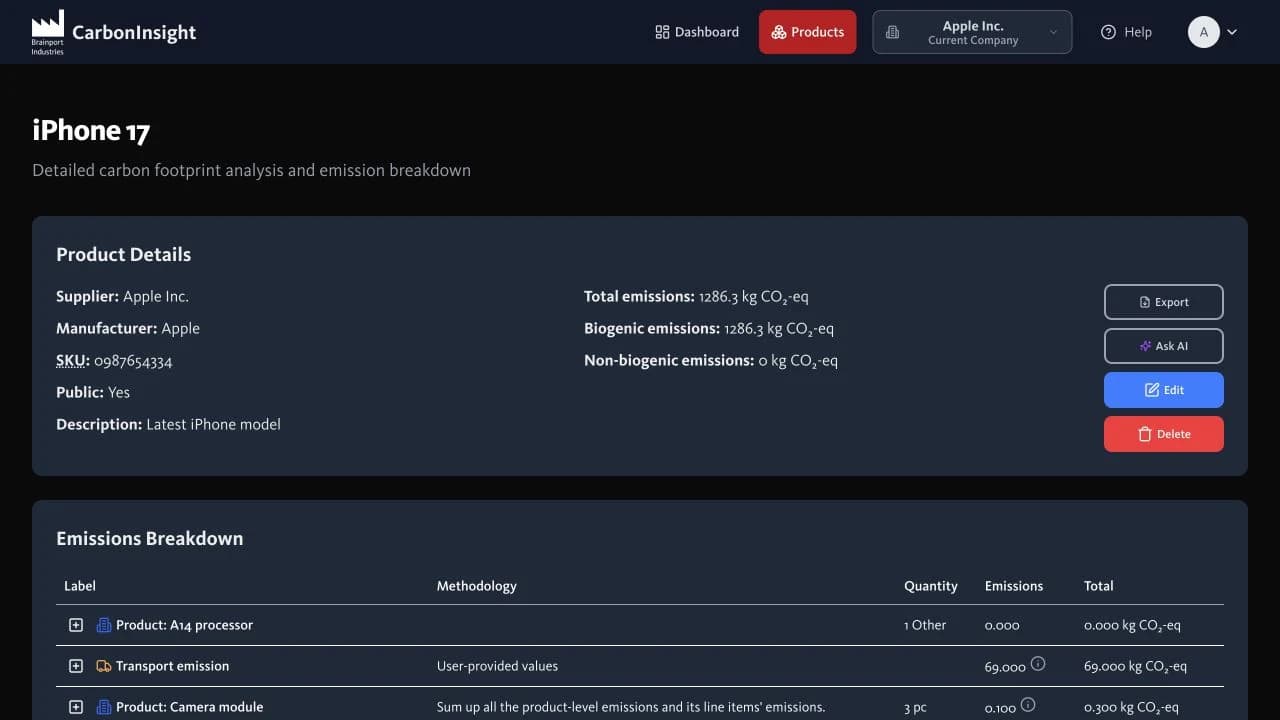
Product footprint and component breakdown in the original app, running locally with sample data. Company names and numbers come from test fixtures.
View full sizeWe built CarbonInsight with Brainport Industries and TU/e as part of the EU-funded AI REDGIO 5.0 initiative, to help manufacturing SMEs calculate product footprints and prepare Digital Product Passport information.
Calculating the footprint
The core is a supply-chain model: a product is a bill of materials made of other products, and its footprint is computed recursively down that tree, rolling each child's emissions up by quantity and splitting them across lifecycle stages. Because suppliers' bills of materials can reference each other, saving one runs a cycle check first so the graph can't close a loop on itself.
Companies can request footprint data from each other through an approval flow. A partner sees the aggregated result, but not the supplier's underlying emission breakdown.
We also implemented exports in AAS (Asset Administration Shell) and SCSN formats, although the project was not formally certified against either standard.
The backend is Django and Django REST Framework over PostgreSQL with token auth; the frontend is Next.js and TypeScript. Access is scoped per company throughout, and the whole thing ships through CI with tests and coverage.